
If you’ve recently heard people talking about IPTV but aren’t quite sure what it actually means, you’re not alone. Many UK viewers are moving away from traditional television setups and exploring internet-based ways to watch live channels, films, series, and other video content.
So, what is iptv and how does it work uk in practical terms?
IPTV stands for Internet Protocol Television. Instead of receiving television through a traditional aerial, satellite dish, or cable connection, IPTV uses an internet connection to deliver video content to a compatible device.
The technology itself is relatively straightforward. The more important part is understanding how the system works, what equipment you need, how internet quality affects streaming, and how to identify legitimate services.
This guide explains what is iptv and how does it work uk from the ground up, so you can understand the technology before choosing an IPTV service.
What Is IPTV?
Before looking at what is iptv and how does it work uk, let’s define IPTV itself.
IPTV means Internet Protocol Television. The term describes television or video content delivered using an IP network rather than traditional broadcast methods.
With conventional terrestrial television, signals are transmitted through an aerial. Satellite television uses a satellite dish, while cable television relies on a dedicated cable network.
IPTV takes a different approach.
The video travels through an internet connection and is delivered to your television, smartphone, tablet, computer, or compatible streaming device.
Depending on the service, IPTV can provide access to different types of content, including:
- Live television channels
- On-demand programmes
- Films
- TV series
- Catch-up content
- News
- Documentaries
- Other video services
One important point is often misunderstood: IPTV is a delivery technology, not automatically a type of illegal television service.
The legality depends on the content and whether the provider has the necessary rights to distribute it.
What Is IPTV and How Does It Work UK?
Now let’s answer the main question directly: what is iptv and how does it work uk?
The easiest way to understand the process is to imagine ordering a video through the internet.
First, the content provider prepares the video for online delivery. The video is encoded and compressed so that it can be transferred efficiently.
When you select a programme or channel, your IPTV application sends a request to the relevant server. The server then sends the video data through your internet connection.
Your device receives that data and plays it almost immediately.
The basic process looks like this:
Content source → IPTV platform → Internet → IPTV application → Your device → TV screen
Unlike downloading a complete video file, streaming normally sends the content in small portions while you watch.
This allows playback to begin within seconds rather than requiring you to wait for the entire programme to download.
How Does IPTV Streaming Actually Work?
Understanding what is iptv and how does it work uk becomes much easier when the process is broken into individual steps.
1. Content Is Prepared
The first stage involves the television programme, film, live broadcast, or other video content.
For legitimate services, the provider needs appropriate distribution rights for the content.
The video is then encoded into a suitable digital format.
2. Video Is Compressed
Raw video files can be enormous.
Compression reduces the amount of data required without unnecessarily sacrificing image quality.
This is particularly important for HD and 4K streaming because higher resolutions require considerably more data.
3. The Stream Is Delivered Over the Internet
Once the content has been prepared, it can be delivered through an IP network.
When you select something to watch, your device connects to the relevant streaming infrastructure and begins receiving the video.
This is the key difference between IPTV and traditional television broadcasting.
4. Your Device Decodes the Stream
Your Smart TV, streaming box, smartphone, computer, or other compatible device receives the data.
The application then processes the stream and displays the video on your screen.
This entire process happens extremely quickly.
What Do You Need for IPTV in the UK?
If you’re researching what is iptv and how does it work uk, you’ll probably also want to know what equipment is necessary.
The good news is that you generally don’t need complicated hardware.
A Stable Internet Connection
Your broadband connection is one of the most important parts of the setup.
As a general guideline:
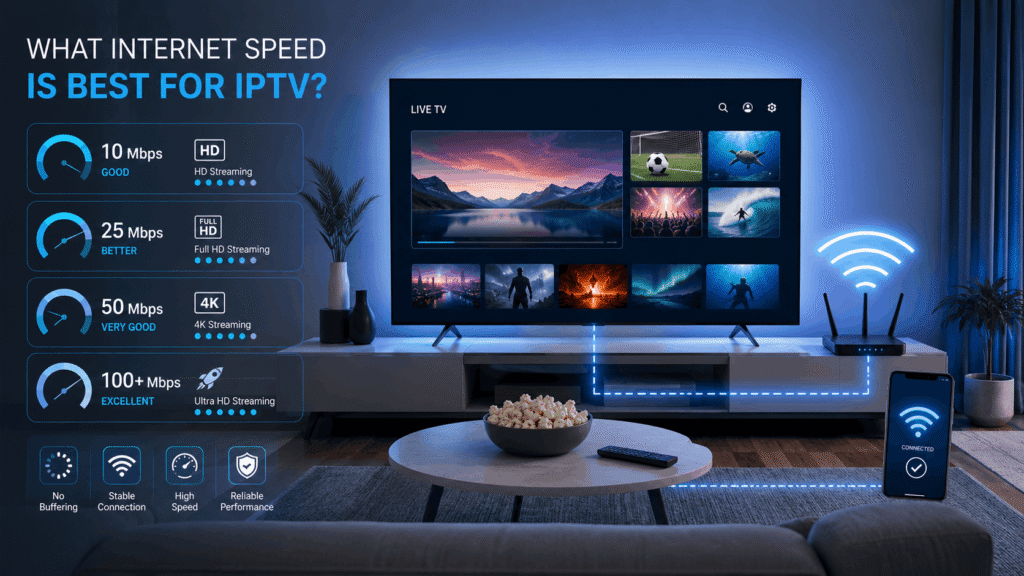
- SD: around 5 Mbps or more
- HD: around 10 Mbps or more
- Full HD: around 10–15 Mbps or more
- 4K: often 25 Mbps or more
These figures are only general recommendations. Actual requirements depend on the streaming service, compression technology, video bitrate, and network conditions.
More importantly, stability matters.
A connection that constantly drops or suffers from packet loss can cause buffering even if the advertised download speed looks impressive.
A Compatible Device
IPTV can potentially work across a variety of devices, including:
- Samsung Smart TVs
- LG Smart TVs
- Android TV devices
- Google TV devices
- Streaming boxes
- Computers
- Smartphones
- Tablets
Always check the service’s official compatibility information before subscribing.
An IPTV Application
Depending on the provider, you may use an official application, website, or compatible media player.
The application acts as the interface between the streaming service and your device.
It can allow you to browse channels, search for programmes, view electronic programme guides, and play available content.
What Is IPTV and How Does It Work UK Compared With Traditional TV?
Another useful way to understand what is iptv and how does it work uk is to compare it with conventional television.
| Feature | IPTV | Terrestrial TV | Satellite TV | Cable TV |
|---|---|---|---|---|
| Delivery method | Internet | Aerial | Satellite | Cable |
| Internet required | Yes | No | Usually no | Not always |
| On-demand content | Common | Limited | Available through some services | Common |
| Device flexibility | High | Lower | Moderate | Moderate |
| Installation | Usually simple | Aerial required | Dish required | May require installation |
The biggest difference is the delivery infrastructure.
With IPTV, your internet connection acts as the pathway between the content provider and your device.
That can make internet television particularly convenient for households that already have reliable broadband.
What Internet Speed Is Best for IPTV?
One of the most common questions surrounding what is iptv and how does it work uk is whether a fast broadband package is necessary.
The answer depends on what you are watching.
Standard-definition video uses relatively little bandwidth. HD requires more, while 4K can require substantially more.
However, simply having a fast broadband package isn’t enough.
Your actual viewing experience can also depend on:
- Wi-Fi signal strength
- Router performance
- Network congestion
- Household internet usage
- Server capacity
- Device performance
- Video bitrate
- Streaming application
For a television that stays in one place, an Ethernet connection can often provide a more consistent connection than Wi-Fi.
Why Does IPTV Buffer?
If you’re learning what is iptv and how does it work uk, buffering is another important topic to understand. If you’re experiencing frequent buffering, our guide on how to stop IPTV buffering in the UK covers practical solutions.
Buffering occurs when the device isn’t receiving video data quickly or consistently enough to maintain playback.
There can be several reasons.
Weak Wi-Fi
Your router might be in another room, behind furniture, or too far away from the television.
Network Congestion
If several people are downloading large files, gaming online, making video calls, or streaming simultaneously, available bandwidth can become limited.
Server Problems
The problem isn’t always at home.
If a streaming server is overloaded, playback may become unstable even when your broadband connection is working correctly.
Device Limitations
Older Smart TVs or low-powered streaming devices can sometimes struggle with demanding video formats.
Application Problems
An outdated or poorly optimised application can also affect playback.
If you’re troubleshooting buffering, start by testing your internet connection on the same device that is experiencing the problem.
IPTV on Smart TVs
For many people, the easiest answer to what is iptv and how does it work uk involves a Smart TV.
Modern televisions can connect directly to the internet, allowing compatible applications to be installed without requiring a separate computer.
Depending on the television manufacturer, you may have access to different application stores and operating systems.
Common platforms include:
- Samsung Smart TV
- LG Smart TV
- Android TV
- Google TV
The exact availability of applications varies between models and regions.
Before paying for a service, check whether your specific television is supported rather than assuming that every Smart TV works in exactly the same way.
IPTV on Fire TV, Android TV and Other Devices
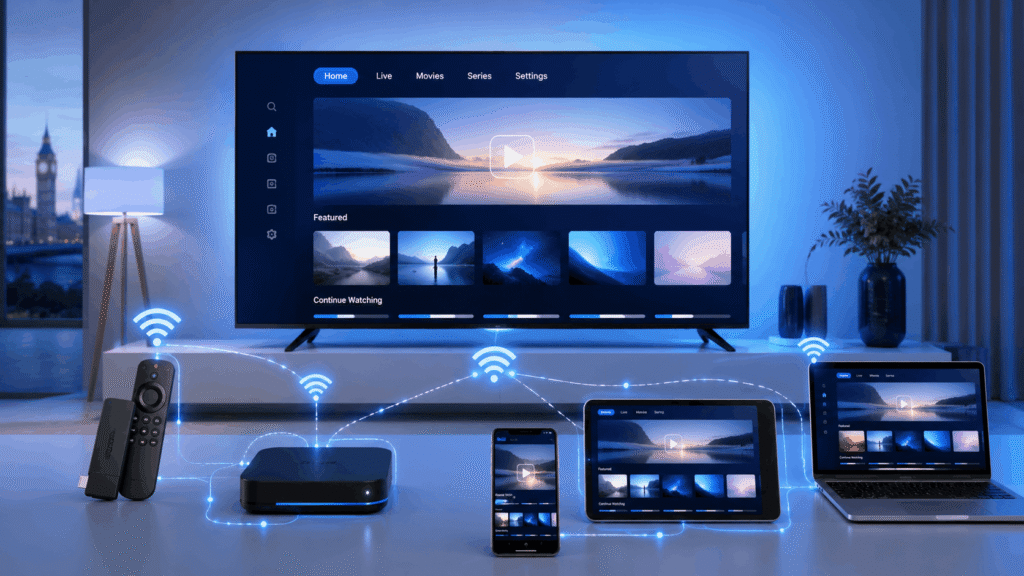
If your television doesn’t support the application you want, you may be able to use a separate streaming device.
A streaming box or stick connects to your television through HDMI and accesses content using your internet connection.
This approach can be useful because the streaming device handles the application and playback instead of relying entirely on your television’s built-in software.
When researching what is iptv and how does it work uk, remember that the device and the IPTV service are two separate things.
Buying a particular streaming device does not automatically provide television content.
You still need an appropriate, authorised service or application.
Is IPTV Legal in the UK?
This is perhaps the most important part of understanding what is iptv and how does it work uk.
IPTV technology itself is legal.
The legal question concerns the content being distributed.
A company can legally use IPTV technology to deliver television programming if it has the necessary rights or licences.
Problems arise when copyrighted television programmes, films, sports, or other content are redistributed without permission.
When evaluating an IPTV service, look for transparency.
A legitimate provider should ideally make it clear:
- Who operates the service
- What content it provides
- What its terms and conditions are
- How customers can contact support
- What payment and cancellation policies apply
- Whether the content is properly authorised
Be cautious about services that make extraordinary promises while providing little information about their business or content rights.
Benefits of IPTV for UK Viewers
Once you understand what is iptv and how does it work uk, the advantages become easier to see.
Flexible Viewing
IPTV can allow viewers to access content through different compatible devices rather than being tied to one television setup.
On-Demand Content
Many modern internet television platforms combine live channels with on-demand libraries.
Easy Access
If you already have broadband and compatible hardware, getting started can be relatively simple.
High-Quality Video
Depending on the service and connection, IPTV can support HD, Full HD, and 4K video.
Modern Interfaces
Electronic programme guides, search functions, categories, favourites, and recommendations can make navigation easier.
Potential Disadvantages of IPTV
There are drawbacks too.
Because IPTV depends on internet connectivity, a broadband outage can interrupt your viewing.
Other potential issues include:
- Buffering
- Application compatibility problems
- Weak Wi-Fi
- Server congestion
- Poor customer support
- Unclear subscription conditions
- Services with questionable licensing
This is why the cheapest option isn’t necessarily the best option.
Reliability, transparency, compatibility, and legal authorisation should all be considered before subscribing.
How to Choose a Reliable IPTV Service in the UK
If you’re now clear on what is iptv and how does it work uk, the next step is knowing what to look for in a provider. For more guidance, explore our best UK IPTV subscription guide, which covers the key features to consider before subscribing.
Check Compatibility
Make sure the service works with your particular Smart TV, streaming device, phone, tablet, or computer.
Check the Terms
Read the subscription conditions before paying.
Pay attention to renewal policies, cancellation terms, supported devices, and refund conditions.
Look for Transparent Information
A professional service should provide clear information about its company, support channels, and content.
Don’t Focus Only on Channel Numbers
A huge channel count doesn’t necessarily mean a better viewing experience.
A stable service with appropriate content rights and good support is more valuable than an enormous list of channels that may not work reliably.
Check Your Internet Connection
Before blaming the IPTV provider for buffering, make sure your own network is capable of handling the selected video quality.
Ethernet can be particularly useful for televisions and streaming boxes.
The Future of IPTV in the UK
The answer to what is iptv and how does it work uk is becoming increasingly relevant as television habits change.
Viewers now expect content to be available when and where they want it.
Traditional broadcasting remains important, but internet delivery has introduced a more flexible approach to television.
Streaming platforms, catch-up services, live television applications, and IPTV technologies are increasingly becoming part of the same broader digital entertainment ecosystem.
For consumers, this means more choice — but also more responsibility when deciding which services to trust.
Frequently Asked Questions
What is IPTV and how does it work UK?
What is iptv and how does it work uk can be answered simply: IPTV is television delivered through an internet protocol network. Content is sent from a provider’s infrastructure through the internet to a compatible application or device, where it is decoded and displayed.
Do I need fibre broadband for IPTV?
No. Fibre broadband isn’t strictly required, but a stable and sufficiently fast connection is recommended, particularly for HD and 4K streaming.
Can IPTV work on a Smart TV?
Yes, provided the television and service are compatible. Samsung, LG, Android TV, and Google TV devices may support different IPTV applications.
Is IPTV legal in the UK?
The technology is legal. The legality of a particular IPTV service depends on whether the provider has the necessary rights to distribute the content it offers.
Why does IPTV keep buffering?
Buffering can be caused by weak Wi-Fi, insufficient bandwidth, network congestion, overloaded servers, outdated applications, or device limitations. Testing your connection and using Ethernet can help identify the issue.
Can I use IPTV without Wi-Fi?
Yes. IPTV requires an internet connection, but that connection doesn’t have to be wireless. A compatible device can connect to your router using an Ethernet cable.
Is IPTV better than traditional television?
It depends on your needs. IPTV can offer greater flexibility and on-demand functionality, while traditional television can remain useful for viewers who prefer conventional broadcasting and don’t want to depend on broadband.
Conclusion
By now, what is iptv and how does it work uk should be much clearer.
IPTV is essentially a method of delivering television and video content through an internet connection. The content is prepared and encoded, transferred through an IP network, received by your device, and played through a compatible application or platform.
The technology offers plenty of flexibility, but the quality of your experience depends on several factors: internet stability, device compatibility, application performance, server capacity, and the reliability of the provider.
Most importantly, don’t judge an IPTV service solely by its price or the number of channels it claims to offer. Check compatibility, read the terms, investigate the provider, and make sure the content is properly authorised.
For UK viewers, the best approach is to choose a secure, stable, transparent, and legally authorised streaming solution that fits your devices and viewing habits.